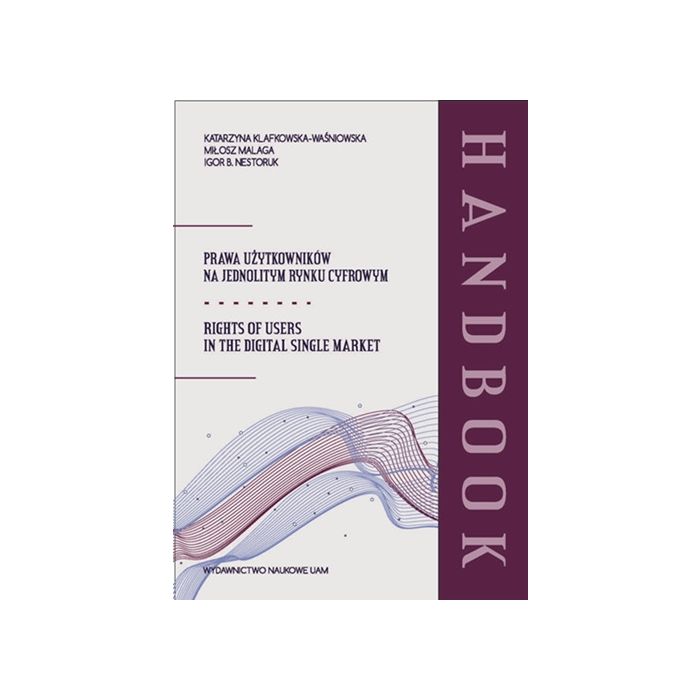
Prawa użytkowników na jednolitym rynku cyfrowym. Rights of users in the Digital Single Market. Handbook
- ISBN: 978-83-232-4438-7
- DOI: 10.14746/amup.9788323244387
- Kategoria: Otwarty dostęp, Prawo
- Data wydania: 2025
- Format: PDF

Celem publikacji jest wyjaśnienie oraz poddanie krytycznej analizie zagadnień związanych z prawną pozycją użytkowników oraz samymi prawami użytkowników na jednolitym rynku cyfrowym.
W ostatnich latach katalog unijnych rozporządzeń, dyrektyw, jak również dokumentów typu soft law, obejmujących swoim zakresem różnorodną problematykę jednolitego rynku cyfrowego, powiększył się w sposób znaczący.
Użytkownicy, czyli odbiorcy usług, konsumenci, użytkownicy biznesowi oraz końcowi, pozostają w rezultacie w samym centrum ram regulacyjnych dla jednolitego rynku cyfrowego. Stąd też publikację rozpoczyna omówienie samej koncepcji, a także rozwoju tych ram regulacyjnych, aby w dalszej kolejności główną uwagę poświęcić analizie takim zagadnieniom jak wzmocnienie ochrony praw podstawowych użytkowników w obszarze moderacji treści na tle przepisów DSA czy mapowanie korzyści dla konsumentów również na gruncie przepisów DSA, prywatno- oraz publicznoprawne narzędza egzekwowania przepisów DSA i DMA. W tym ostatnim obszarze można obserwować dopiero wstępną fazę kształtowania się ram dla nadzoru, egzekwowania czy monitorowania, co pozwala jednocześnie prześledzić przykłady synergii oraz różnic w podejściu, które unijny prawodawca przyjął w obu rozporządzeniach. Jako kluczowe jawią się tutaj następujące pytania: Czego w zasadzie użytkownik może oczekiwać na polu stosowania instrumentów public enforcement? Kiedy indywidualne roszczenia oraz skargi powinny stanowić realnie dostępną opcję ochrony interesów użytkowników?
Wykaz skrótów
Wprowadzenie
Rozdział I
Jednolity rynek cyfrowy i ochrona użytkowników – ramy prawne
1.1. Pojęcie jednolitego rynku cyfrowego – wprowadzenie
1.2. Pakiet o usługach cyfrowych a priorytety legislacyjne dla „Cyfrowej Europy”
1.3. Od dyrektywy w sprawie handlu elektronicznego do Aktu o usługach cyfrowych
1.3.1. Swoboda przepływu usług społeczeństwa informacyjnego
1.3.2. Wyłączenia odpowiedzialności w dyrektywie o handlu elektronicznym
1.3.3. Regulacja działalności platform internetowych – droga do DSA
1.4. Unijna polityka ochrony konsumentów wobec transformacji cyfrowej
1.5. Od prawa konkurencji do Aktu o rynkach cyfrowych
1.5.1. Relacja między prawem konkurencji UE a Aktem o rynkach cyfrowych
1.5.2. Ogólna charakterystyka rynków cyfrowych oraz cele DMA
1.6. Podsumowanie
Rozdział II
Moderowanie treści i prawa użytkowników w Akcie o usługach cyfrowych – wzmacniane czy zaniedbane?
2.1. Wprowadzenie
2.2. Wzmocnienie pozycji użytkowników w zakresie moderowania treści
2.2.1. Zachęcanie do moderowania na platformach
2.2.2. „Prawo” do zgłaszania treści
2.3. Transparentność moderowania dla użytkowników: prawo do bycia poinformowanym
2.4. Podsumowanie
Rozdział III
Zasada ochrony praw konsumentów w Akcie o usługach cyfrowych – mapowanie
korzyści dla konsumentów
3.1. DSA a unijne prawo konsumenckie
3.2. Konsument jako podmiot w DSA
3.3. Konsument jako podmiot w DSA na platformach B2C
3.3.1. Wyjątek konsumencki przy odpowiedzialności za usługi hostingu
3.3.2. Należyta staranność platform B2C wobec konsumentów
3.4. Wybrane przepisy DSA z perspektywy konsumenckiej
3.4.1. Warunki korzystania z usług
3.4.2. Reklama internetowa
3.4.3. Ochrona małoletnich
3.5. Podsumowanie
Rozdział IV
Uprawnienia przyznane uczestnikom rynków cyfrowych przez Akt o rynkach
cyfrowych
4.1. Wprowadzenie
4.2. Kluczowe podobieństwa i różnice między DMA a prawem konkurencji
4.3. Akt o rynkach cyfrowych jako źródło uprawnień użytkowników platform
4.3.1. Bezpośredni skutek prawa konkurencji UE
4.3.2. Bezpośredni skutek DMA
4.4. Beneficjenci Aktu o rynkach cyfrowych
4.4.1. Wprowadzenie
4.4.2. Użytkownicy biznesowi
4.4.3. Użytkownicy końcowi
4.5. Uprawnienia zawarte w DMA
4.5.1. Obowiązki strażników dostępu
4.5.2. Prawa przyznane wspólnie użytkownikom biznesowym i końcowym
4.5.2.1. Korzystanie oraz dostęp do danych użytkowników
4.5.2.2. Interoperacyjność oraz podobne uprawnienia
4.5.2.3. Interoperacyjność usług łączności interpersonalnej niewykorzystujących numerów
4.5.2.4. Dostęp do treści między platformami, kierowanie użytkowników oraz wiązanie usług
4.5.2.5. Klauzule najwyższego uprzywilejowania
4.5.2.6. Skuteczność i rezygnacja z usługi platformowej
4.5.3. Uprawnienia użytkowników biznesowych
4.5.3.1. Self-preferencing
4.5.3.2. Dostęp do sklepów z aplikacjami na warunkach FRAND
4.5.3.3. Reklamy internetowe
4.6. Podsumowanie
Rozdział V
Dochodzenie praw i sądowa ochrona użytkowników na rynku cyfrowym
5.1. Wprowadzenie
5.2. Egzekwowanie DMA przez organy publiczne
5.2.1. Wprowadzenie
5.2.2. Szczególne elementy podejścia ex ante
5.2.3. Niewypełnianie obowiązków
5.3. Egzekwowanie DSA na drodze publicznoprawnej
5.3.1. Właściwe organy krajowe i koordynatorzy do spraw usług cyfrowych
5.3.2. Uprawnienia w zakresie egzekwowania. Sankcje
5.3.3. Egzekwowanie w odniesieniu do VLOP/VLOSE
5.3.4. Spory użytkowników z platformami – rola DSC
5.4. Egzekwowanie DSA na drodze prywatnoprawnej
5.5. Egzekwowanie przez podmioty prywatne uprawnień wynikających z DMA
5.5.1. Kontekst systemowy
5.5.2. Uprawnienia podlegające egzekwowaniu przez podmioty prywatne
5.6. Podsumowanie
Konkluzje
Wykaz źródeł
Contents
Abbreviations
Introduction
Chapter I
Digital Single Market and the regulatory framework for rights of users
1.1. The concept of the Digital Single Market – Introduction
1.2. Digital Services Package as part of shaping Digital Europe legislative initiatives
1.3. From e-commerce to the DSA
1.3.1. Freedom to provide information society services
1.3.2. Liability exemptions in the ECD
1.3.3. Regulating online platforms – the road to the DSA
1.4. EU Consumer Protection Policy towards Digital Transformation
1.5. From Competition Law to the Digital Markets Act
1.5.1. Interplay between EU competition law and the Digital Markets Act
1.5.2. Overall characteristics of digital markets and DMA’s goals
1.6. Conclusions
Chapter II
Content moderation and rights of users in the Digital Services Act – protected or neglected?
2.1. Introduction
2.2. User empowerment in content moderation
2.2.1. Incentives for moderation
5.2.2. “Right” to report
2.3. Transparency of content moderation for users: right to be informed
2.4. Conclusions
Chapter III
The principle of consumer protection under the Digital Services Act – mapping consumer benefits
3.1. The Digital Services Act and EU consumer law
3.2. Consumers in the Digital Services Act
3.3. Provisions of the DSA dedicated to consumer protection on B2C platforms
3.3.1. Consumer exception within the liability for hosting services
3.3.2. Due diligence of B2C platforms towards consumers
3.4. Selected DSA provisions from the consumer perspective
3.4.1. Terms and conditions of the services
3.4.2. Online advertising
3.4.3. Protection of minors
3.5. Conclusions
Chapter IV
Rights granted upon digital markets participants by the Digital Markets Act
4.1. Introduction
4.2. Key similarities and differences between the DMA and competition law
4.3. The Digital Markets Act as a source of platform users’ rights
4.3.1. Direct effect of EU competition law
4.3.2. Direct effect of the DMA
4.4. Beneficiaries of the Digital Markets Act
4.4.1. Introduction
4.4.2. Business users
4.4.3. End users
4.5. Rights included in the DMA
4.5.1. Gatekeepers’ obligations
4.5.2. Rights enjoyed by both business as well as end users
4.5.2.1. Use and access to users’ data
4.5.2.2. Interoperability and similar rights
4.5.2.3. NI-ICS interoperability
4.5.2.4. Cross-platform access to content, anti-steering and tying
4.5.2.5. Most Favoured Nation
4.5.2.6. Effectiveness and termination
4.5.3. Business users’ rights
4.5.3.1. Self-preferencing
4.5.3.2. Access to application stores on FRAND conditions
4.5.3.3. Online advertising
4.6. Conclusions
Chapter V
Enforcement and judicial protection of users in the digital market
5.1. Introduction
5.2. Public enforcement of the Digital Markets Act
5.2.1. Introduction
5.2.2. Specific elements of ex-ante enforcement
5.2.3. Non-compliance proceedings and decisions
5.3. Public enforcement of the Digital Services Act
5.3.1. Competent authorities and Digital Services Coordinators
5.3.2. Supervision and enforcement powers
5.3.3. Enforcement over VLOPs and VLOSEs
5.3.4. Users’ disputes with online platforms and the role of DSCs
5.4. Private enforcement of the Digital Services Act
5.5. Private enforcement of the Digital Markets Act
5.5.1. Systemic background
5.5.2. What rights can be enforced and how
5.6. Conclusions
Conclusions
Sources
The purpose of this handbook is to explain and critically analyse the position of users and rights of users in the digital single market.
In the recent four years the body of regulations and directives addressing the digital single market has grown substantially. Users' rights are for example specifically addressed in the Data Act, and the logie of identifying and sustaining users' rights is already present in the GDPR. Out of this complex body of the regulatory instruments we chose to focus on the Digital Services Act and Digital Markets Act.
Users, understood as service recipients, consumers, business and end-users, are thus in focus of the regulatory framework for Digital Single Market. In this handbook we firstly discuss the concept and evolution of the regulatory framework for the Digital Single Market (chapter I) and then move on to separately analyse three key problems: (1) enhancing the protection of fundamenta! rights of users in the area of content moderation under the DSA; (2) mapping consumer benefits under the DSA; and (3) the scope of rights granted upon digital markets participants by the Digital Markets Act.
The last chapter is therefore dedicated to the issue of public and private enforcement of the DSA and the DMA. Here, we observe how the enforcement framework is still in the development phase and we underline key synergies and differences in the approach taken in the DSA and the DMA. The ultimate ąuestion is whether it is elear what the user may expect from the public enforcement, and when should the individual claims and complaints be the viable option.
| Informacje szczegółowe | |
|---|---|
| Wprowadzenie |
Pobierz plik

|
| Spis treści |
Pobierz plik
|
|
|
|
| Wersja publikacji | otwarty dostęp |
| Format | |
| Język | polski, angielski |
| Typ publikacji | Monografia |
| Wydanie | I |
| ISBN | 978-83-232-4438-7 |
| DOI | 10.14746/amup.9788323244387 |
| Liczba stron | 234 |
| Liczba arkuszy wydawniczych | 16,50 |